The Oilfield Traffic Problem in Midland
If you own a residential or commercial property in Midland, you know firsthand how heavy oilfield equipment and constant traffic can take a toll on asphalt driveways. The Permian Basin's active energy industry means oversized trucks, tankers, and specialized vehicles regularly travel through neighborhoods and commercial areas. These vehicles concentrate enormous weight on relatively small tire contact patches, creating stress that standard residential driveways simply weren't designed to handle.
Beyond the immediate crushing force, the Texas climate adds another layer of complexity. Winter freeze-thaw cycles cause moisture beneath the asphalt to expand and contract, weakening the base layer. When heavy oilfield traffic is layered on top of this seasonal damage, potholes and surface deterioration accelerate dramatically. Many property owners in Midland find themselves facing a critical question: is a quick patch job enough, or does the driveway need complete replacement?
Understanding Pothole Formation and Frost Heave
Potholes don't appear overnight by accident. They form through a predictable sequence of events that begins with small cracks in the asphalt surface. When rain or snowmelt seeps through these cracks, water penetrates the base layers beneath the pavement. In Midland's climate, winter temperatures cause this trapped moisture to freeze, expanding with tremendous force. This expansion pushes the asphalt upward, creating the bumps and heaves you may notice in your driveway or parking lot.
Frost heave driveway damage is particularly common in areas with heavy traffic because the weight of vehicles accelerates the breakdown of the base layer. When the ground thaws in spring, those weakened areas collapse inward, leaving behind the characteristic bowl-shaped depression we call a pothole. Oilfield traffic compounds this problem significantly. A single heavy truck can apply 20,000 to 40,000 pounds of force per axle, compared to 4,000 to 5,000 pounds for a standard passenger vehicle. This concentrated force breaks apart the already-weakened base material, turning small problem areas into large, dangerous holes in just a few weeks.
When Pothole Repair Makes Sense
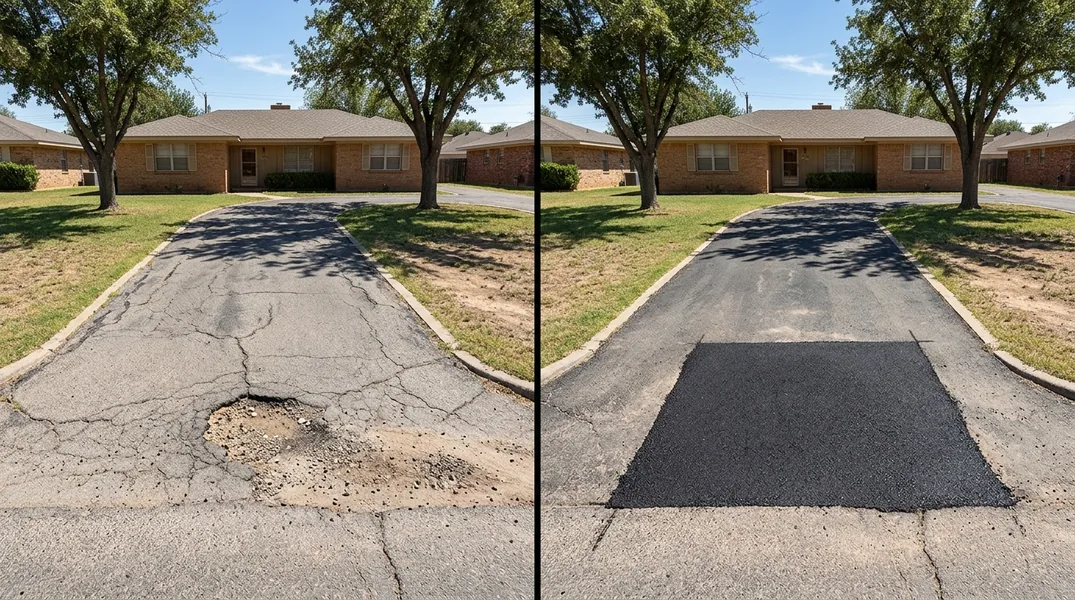
Pothole Repair & Asphalt Patching is a cost-effective solution when damage is limited to a few isolated areas and the surrounding asphalt remains in reasonably good condition. If your driveway has one or two potholes but the rest of the surface is relatively smooth with only minor cracking, patching is likely your best option. A quality patch involves cleaning out the damaged area, preparing the base, and filling it with hot-mix asphalt compacted to match the surrounding surface. When done properly by experienced professionals, a patch can last several years, especially if you address the underlying cause of the damage.
The key advantage of patching is immediate cost savings. Pricing for pothole repair typically ranges from $200 to $800 per hole, depending on size and location, compared to several thousand dollars for full driveway replacement. However, patching works best as a temporary solution when the underlying asphalt structure is still sound. If heavy oilfield traffic continues to stress your driveway, expect patches to fail within 12 to 24 months. This makes patching most sensible for driveways that won't experience ongoing heavy vehicle loads or for homeowners who plan to address larger issues within a year or two.
Signs Your Driveway Needs Full Repaving
Full Driveway Repair through complete repaving becomes necessary when damage is widespread or the structural integrity of the driveway has been compromised. If you see multiple potholes scattered across your driveway, extensive cracking patterns (especially alligator cracking that resembles a spider web), or large areas of surface deterioration, your asphalt has likely reached the end of its serviceable life. In these cases, patching individual holes is like putting a band-aid on a broken leg. The underlying base layer has failed, and new holes will continue forming in different locations as traffic stresses the weakened foundation.
Frost heave driveway damage that affects large sections of your pavement also indicates the need for repaving rather than repair. When the ground beneath your driveway has become unstable due to repeated freeze-thaw cycles combined with heavy vehicle loads, simply resurfacing won't solve the problem. The heaving and settling will continue, and new cracks will form in any new asphalt applied to an unstable base. Additionally, if your driveway is more than 15 to 20 years old and showing signs of general deterioration across most of its surface, repaving is almost always more economical than repeated patching over time.
Asphalt Resurfacing as a Middle Ground
For driveways that aren't quite ready for complete removal and replacement, Asphalt Resurfacing & Overlay offers a practical middle option. This process involves applying a new layer of asphalt over the existing surface, essentially giving your driveway a fresh top coat while preserving the base layer. Resurfacing works well when the base structure is still relatively sound but the top surface has become rough, cracked, or worn. This approach costs less than full repaving (typically 40 to 60 percent of the price) while providing a much longer lifespan than simple patching.
However, resurfacing has limitations, particularly in areas subject to heavy oilfield traffic. If the base layer has been significantly weakened by frost heave or years of heavy vehicle loads, applying a new surface layer won't address the underlying problem. The new asphalt will eventually crack and fail as the unstable base continues to shift. Before choosing resurfacing, it's essential to have a professional assessment of your driveway's base condition. This is where calling Midland Asphalt Paving at (432) 289-5378 makes sense. Our team can evaluate whether your driveway's foundation is still sound enough for resurfacing or whether full reconstruction is necessary for long-term durability.
Making the Repair or Replace Decision
The choice between pothole repair, resurfacing, and full repaving ultimately depends on three factors: the extent of current damage, the condition of the base layer, and the expected future traffic loads on your driveway. If you have isolated potholes, minimal cracking elsewhere, and don't expect continued heavy oilfield traffic, patching makes financial sense. If damage is more widespread but the base is sound and you want to extend your driveway's life, resurfacing is worth considering. If you're facing multiple problem areas, extensive cracking, or unstable ground conditions, repaving is the only solution that will provide reliable performance for the next 15 to 20 years.
The most important step is getting a professional evaluation from someone who understands the specific challenges that oilfield traffic creates in Midland. Midland Asphalt Paving has years of experience dealing with driveways damaged by heavy equipment and harsh weather conditions. We can assess your specific situation and recommend the most cost-effective solution. Contact us today for a free estimate or call (432) 289-5378 to discuss your driveway's needs. We'll help you understand whether you need a quick patch, a resurfacing project, or a complete Asphalt Driveway Paving & Installation to restore your property's appearance and functionality.
Looking for a professional asphalt paving contractor in Midland? Midland Asphalt Paving responds fast for all your asphalt paving needs.
Get a Free Quote